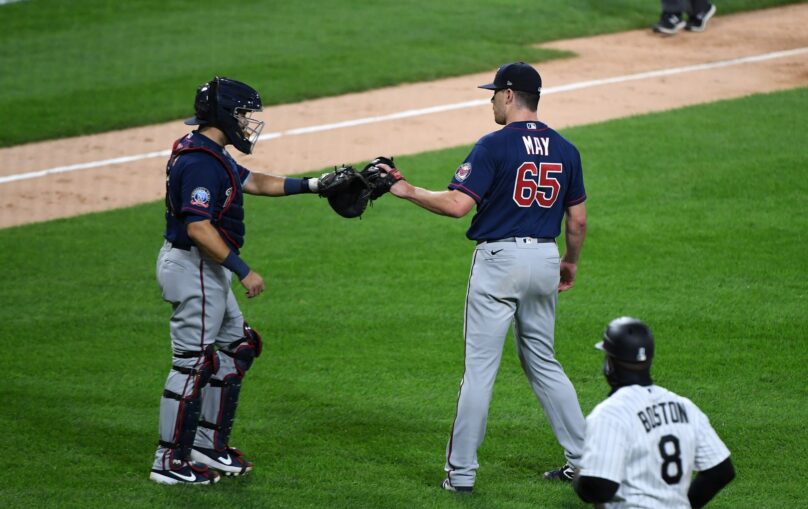
Credit: Mike Dinovo-USA TODAY Sports
It’s officially happening, you guys.
The New York Mets made their first significant move of the offseason Tuesday by agreeing to sign reliever Trevor May to a two-year deal worth $15.5 million, according to reports. Remember when we’d worry about this being the most significant move of New York’s winter? Those days are long gone.
Other reports are showing us more “irons are in the fire” as the Mets prepare for a crucial 2021 season as a franchise. This is a tremendous start, though, as May’s acquisition will (hopefully) help stabilize a bullpen that’s been inconsistent in recent years.
Outside of the obvious stuff — like the high strikeout rate he’ll bring alongside Edwin Diaz and company — here are three areas May should immediately help upon landing in Flushing for the next couple years.
Walk Rate
As a unit, the Mets’ bullpen has watched its cumulative walk rate go up each season since 2018 (9.4%, 9.9%, and 12.6%). That high 2020 number is likely inflated because only 60 games were played, but still, it’s a number that needs to dip back down next year. During that same period of time, May has produced a walk rate better than the Mets’ collective rate each year (4.9%, 9.8%, and 7.3%).
What was noticeable about Mets relievers this past year is even those who had a good year couldn’t keep their respective walk rates down. Among New York hurlers who racked up at least 10 innings out of manager Luis Rojas‘ bullpen in 2020, only Erasmo Ramirez (7.5%) and Seth Lugo (5.0%) produced a walk rate below 10.5%. The rest (Diaz, Brad Brach, Dellin Betances, Jeurys Familia, Franklyn Kilome, Jared Hughes, Chasen Shreve, and Justin Wilson) all found themselves in double digits.
Most late-game relievers who are called upon in high-leverage situations on a regular basis typically share the same quality: they don’t enter the game and allow a ton of free passes. That’s a good quality to have, and it’s nice to see May comes with that kind of reputation.
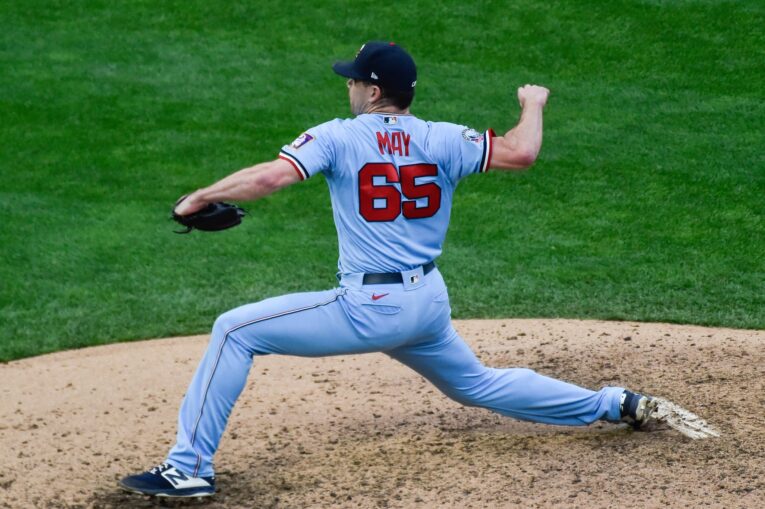
Credit: Jeffrey Becker-USA TODAY Sports
Strand Rate
Not allowing walks is great, but ya know, there are going to be times when it happens. When pitchers are faced with those situations, it’s comforting to watch them escape jams while stranding runners more often than not. As you can imagine, this is an area where New York’s bullpen has struggled in recent years.
In 2018, Mets relievers produced a collective strand rate of 70.0%, which was the third-worst mark in baseball. They improved in this area during 2019 with a 72.1% clip but still finished in the lower half of the league. They finished in the top half of the league in 2020, but the number itself didn’t climb much (72.8%).
Once again, May is arriving with a solid three-year track record of success in this category, posting rates of 84.1%, 78.9%, and 80.0% since 2018. As a frame of reference, these percentages have been comfortably above the league average each year (73.1% in ’18, 72.8% in ’19, 71.5% in ’20). It’s also worth noting that wOBA from opposing hitters has progressively gotten worse as runners advance to scoring position the last couple years against May.
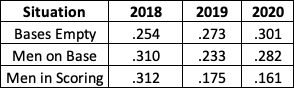
That’s exactly the type of dependability the Mets need late in ballgames to hold leads.
Controlling the Zone
Although this can go hand-in-hand with walk rate, it’s still different, so here we are. Something I noticed while looking around at May’s stats — other than the perfectly symmetrical parts of his 2020 campaign — was that he’s consistently thrown a lower percentage of pitches in the strike zone, while getting a higher percentage of first-pitch strikes.
Here’s a brief look at how these two statistics have progressed between 2018 and 2020:
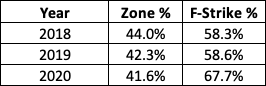
The Mets’ bullpen has been spending less time in the strike zone (45.6% in ’18, 43.0% in ’19, 38.7% in ’20), but there hasn’t been any growth with regard to first-pitch strikes (60.2% in ’18, 57.6% in ’19, 58.1% in ’20).
Why This Signing Feels Different
It’s easy to jump on this free-agent acquisition and start praising the front office, and they should be getting some props right now. They found a way to legitimately stabilize what’s been an inconsistent bullpen. Could it all crash and burn, eventually making this signing a complete disaster?
Well, sure — that’s the risk any team takes. The difference here is Sandy Alderson and company identified a player they wanted at the top of the market based off his recent track record and struck a deal. Around this time last year, there was some excitement about Betances coming to Queens (I was excited about it), but the signing came with lots of unknowns because the righty barely pitched in 2019 because of injuries.
And as we saw in 2020, the initial returns on Betances the Met hasn’t been great. There’s now flexibility in the budget to pay up for players who are at the top of the market because they’ve proven to be healthy and productive in the years leading up them becoming available. New York no longer has to look for flawed players or those coming off injury to get a discount and hope they bounce back or exceed expectations, and that’s a beautiful thing.