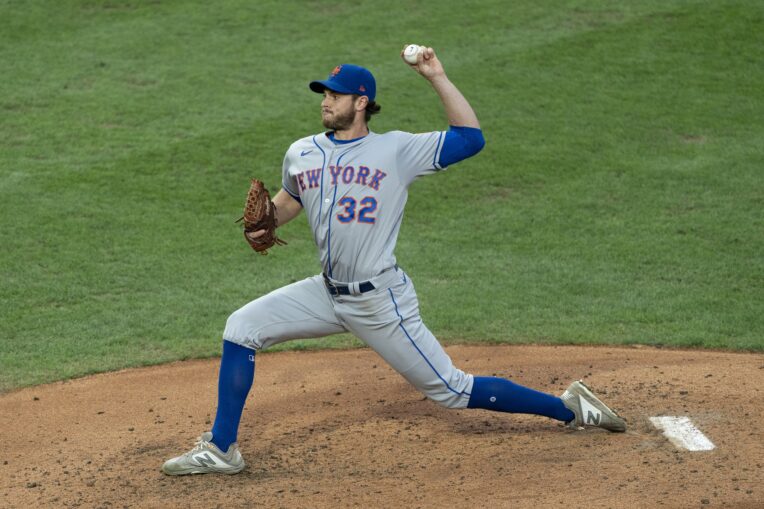
Steven Matz
Player Data: Age: 29, R/L
Primary Stats: 9 G (6 starts), 0-5, 30.2 IP, 9.68 ERA, 1.696 WHIP, 42 H, 33 ER, 14 HR, 10.6 K/9, 2.9 BB/9
Advanced Stats:44 ERA+, -1.0 bWAR, -0.7 fWAR, 7.76 FIP, 4.15 xFIP, .314 BABIP, 25.4 K%, 7.0 BB%
Free Agent: 2022
2020 Salary: $5 million ($1.8 million prorated)
Grade: F
2020 Review
Damn. It’s been a long time since Grandpa Matz was cheering on his grandson in his debut back in 2015.
It’s not a stretch to say this was Steven Matz‘s worst year as a major league pitcher. After a strong ending to 2019 (he had a 3.52 ERA in the second half last year), Matz had one start–his first one–that lasted six innings.
The Long Island-native allowed runs in eight of his nine appearances (six starts and three relief appearances), including a 12-day stretch at the beginning of August where he allowed 19 earned runs over 11.2 innings.
Over those 11.2 innings, he allowed 20 hits, three walks, six home runs, and five doubles. He was moved to the bullpen after that and didn’t pitch for two weeks. He had one more start and three bullpen appearances (five innings, four runs) after that. He finished the year with a 9.68 ERA.
Not good.
Asking what went wrong is probably not the correct question right now, so let’s look at a couple positives from Matz’s year.
First, his strikeout rate was up to 10.6 K/9. His career average is about 8.6 K/9. In a game that currently emphasizes three true outcomes, striking out over 10 guys per nine innings is a plus. Matz also seemed to get his first inning struggles, which were a bug in the 2019 season for the most part, under control.
He allowed two runs in six first innings across his six starts, and allowed one run in the two relief appearances where he started the inning as a new pitcher and didn’t inherit runners. Another bright spot was his change up as a “put away” pitch. He had a 32.8 whiff percentage with it across all counts, and he was able to use it with two-strikes to get strikeouts 22.7 percent of the time, more than any pitch he used.
But as you can see, we’re grasping for straws here. His Baseball Savant page is filled with a lot of blue shading (toward the bottom half of the league in Baseball Savant terms).
Teams just tee’d off on Matz in 2020. He was bottom five percent in the majors with exit velocity, launch angle, hard hit percentage, xBA, and xSLG.
His fastball/sinker, which he throws 53.7 percent of the time, didn’t do him any favors, and neither did his curve. He had .322 and .400 BAA, respectively, on both those pitches. His sinker didn’t really sink, with Matz constantly living in the upper two-thirds of the strike zone with that pitch (according to Baseball Savant’s heat maps), and his curve didn’t reaaaally get out of the zone when he needed it to.
Matz struggled with his control all year, and despite a career high strikeout rate, he struggled with putting people away with two strikes. We may be able to chalk up an uptick in his strikeout rate on batters becoming trigger happy over Matz potentially leaving something in the zone.
Batters had a .314 batting average with two strikes against Matz, and he gave up nine of his 14 homers when batters only had one strike left. Take this pitch for example:
[iframe]<iframe src=”https://streamable.com/m/jose-peraza-singles-on-a-sharp-line-drive-to-left-fielder-j-d-davis” width=”560″ height=”315″></iframe>[/iframe]
After starting 2-0 against Jose Peraza, Matz got even 2-2 with two fastballs that Peraza fouled off. Matz chose a good pitch for the next offering with a curveball–a pitch that Matz threw on average 17 mph slower than his fastball. But the curveball caught the bottom half of the strike zone, and Peraza singled. It’s hard to succeed when you get the count to two strikes then can’t put the batter away.
To be fair to Matz, he isn’t the only Mets starting pitcher from 2020 to earn a below-average grade (Michael Wacha earned an F, too, and Rick Porcello received a D.) But it was just an effort for Matz to get anyone out in any appearance this year. He allowed 52 baserunners. He only got 92 outs.
We all hope to move past 2020 as soon as possible. I’m sure Matz does, too.

2021 Outlook
Of all the starters from 2020 who performed poorly, Matz is the only one whose future with the Mets is actually worth talking about. Matz is entering his final year of arbitration in 2021, making him a free agent come 2022. This is the last season the Mets will have to garner a full look at Matz, wherever that may be. Matz will probably make a slight uptick from his $5 million salary in 2021.
The good thing is, it can’t get worse than it was this year. The only way is up…I think.
Metsmerized has pondered what an extended look in the bullpen would look like for Matz, and honestly, that’s probably where Matz needs to look for value. It’s also been reported Matz was working with Phil Regan in Port St. Lucie this offseason, trying to find his touch from the 2019 season when Regan was his pitching coach for the last half of the year. (Regan also coached Matz for multiple seasons as the St. Lucie pitching coach and other roles for the Mets as Matz developed.)
Whatever Matz finds with Regan, it’s probably best used in the bullpen. The Mets’ rotation is quickly shoring up spots as Marcus Stroman accepted his qualifying offer, David Peterson looks like a viable back-end option, Noah Syndergaard is already pitching off a mound following his surgery (he won’t start the year in the rotation, but a pre-All-Star-break timetable seems promising), and a new owner who seems willing to spend money on needs. Starting pitching is a primary one.
The 29-year-old can look to someone like Drew Pomeranz as a model. The lefty had a couple years of moderate success relying on up to five pitches (fastballs and curves chief among them), but then tanked for a year-and-a-half in Boston and San Francisco, pitching to a nearly 6.00 ERA before being traded to Milwaukee in 2019.
Pomeranz then moved to the bullpen with the Brewers, narrowed his pitch selection to only a fastball and curve, and he became a successful reliever. He parlayed a half-season–in his age-30 season, like Matz will be–in the bullpen into $34 million with the Padres last offseason and had a 1.45 ERA, 300 ERA+ (!!), and 1.0 bWAR in 2020.
Clearly, Matz’s success won’t be compared to Pomeranz’s, nor is it as simple as “narrow your pitch selection, pitch less, and get good.” But ideally Matz can find a groove in a different role. The talent and “stuff,” as they say, is there. It’s worth trying it elsewhere.
Starting depth is something that was quickly needed in 2020, too, so Matz can also serve as a much-needed spot starter or long reliever on bullpen days, should the Mets occasionally choose that route.
Ultimately, the Mets should keep Matz on the roster this season. We’ve seen previous administrations cut bait with cost-controlled guys who have produced in the past due to recent struggles. Travis d’Arnaud is the most recent and extreme example of that, with the Mets tendering him a contract then cutting him after a handful of at-bats. I have a feeling the new administration will try to avoid that.