By Michelle Ioannou
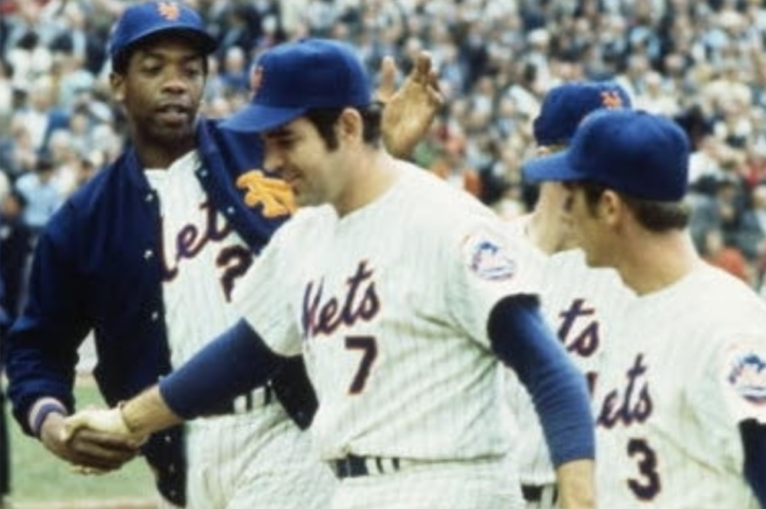
The 2019 Mets season marked the 50th anniversary of the World Champion Miracle Mets. The organization honored the team throughout the season, even having an entire weekend dedicated to the ’69 team at the end of June.
Members of that amazin’ team made their return to Citi Field. And one of them gave a rallying cry to the current Mets team.
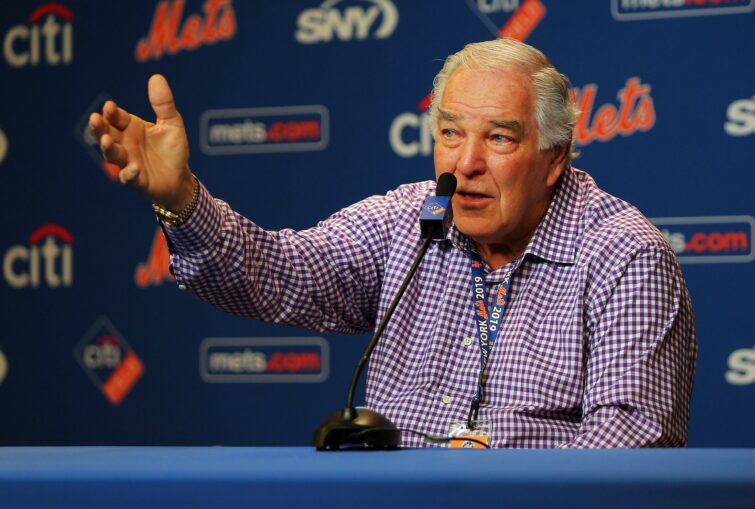
That player was Ed Kranepool.
Kranepool has been in the news recently, not only as the Mets honor his championship winning team, but also as fans everywhere learned of his journey through needing a kidney transplant.
We followed (and prayed) along as it was announced he needed a kidney transplant, when a kidney match was found, and finally when he had successful surgery back in May. Four months later, and I was fortunate enough to speak with the Mets legend, both about his health and of course about the Mets.
Kranepool could not have been more generous and willing to chat with me, even insisting I stop calling him Mr. Kranepool and call him Ed. Thank you, Ed, for letting me pick your brain.
First of all, how are you feeling? We were so glad to hear that everything went okay!
Four months after surgery, I’m regaining my strength and everything seems to be working okay. They did a great job at Stonybrook Hospital. My hospital, Dr. Darras, was wonderful. He’s handled over 1,800 of these surgeries and he’s done very well with them.
That is amazing! I am so, so glad to hear. We are all so grateful that you are doing well! I actually saw you from afar during 1969 weekend where you and the entire ’69 team was honored.
One thing, you made a rallying cry of sorts to this current Mets team to follow in the footsteps of your team in ’69.
Back then, we didn’t imagine the second half of the Mets season would turn out the way it did, with the potential for a Wild Card spot.
What are your thoughts on this season so far? Did you know something back in June that we didn’t?
(while chuckling) Well, you could see that they have a lot of young players and they were not playing up to their potential and they had to be motivated a little bit and that’s what I was trying to do for them – give them a little spark. And they had a spark, they just didn’t have enough cylinders back then – they were playing a little short.
That’s what you need with a young group, it can be very difficult the second half of the season, when you’re on a bad ball club, you’re losing, it’s contagious just like winning is contagious. You gotta learn how to win and win those close games. And they haven’t done that completely.
That was the motivating factor with us. Under our management, Gil Hodges was a great inspirational leader and he got the most out of his players. You know, they’re just lacking slightly now, but it’s certainly a positive sign for next year.
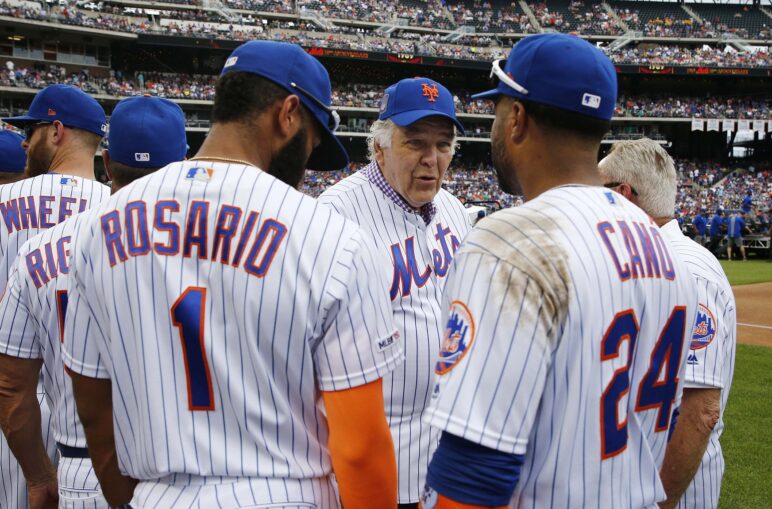
Some of the younger guys had tremendous years and you can build off of that. Alonso at first base, Conforto in right field has done very well, recently coming back from an injury Nimmo is playing well, in center field McNeil has been playing well all year. Those are four key guys.
The shortstop Rosario has had an outstanding year and came on strong the second half and he’s really put it together. So they have five guys who are really there.
And of course, their pitching staff — the guy that could be a Cy Young winner, again, but they have other guys on the pitching staff that have to improve themselves.
Other than deGrom I think everybody else has fallen short of their possible potential. If they can improve next year a bit, those 20 games they lost, those close games, they turn it around. If they win half of those games, they’re in a pennant race.

What parallels do you see between this current Mets team and the ’69 team?
Well, we were all young and the same age and we grew up together. These fellas are about the same age. They’re all together, they came up together, those guys I mentioned earlier. They have the nucleus of a young club and they’re only going to get better.

You broke into the majors at 17-years-old which is unheard of these days. What was it like being such a young player and playing in the majors in New York City?
Well, I was very young, I was 17 in the major leagues which is unusual and is not going to happen. It’s very infrequent. I was forced into the major leagues, probably hurt myself and my career being forced into the major leagues; trying to learn against hall of famers, and that’s what it was in the ’60s and ’70s, a lot of hall of famers when I was playing.
So you don’t learn from those fellas. They get to the Hall of Fame because they take advantage of young, immature players and that’s what I was. It took me five or six years to develop and by that time we had lost 600 games and fans were getting a bit rowdy, even against myself. It made it difficult.
But we turned it around in ’69 and I was very fortunate to still be there. They made so many moves with their roster and I was lucky I wasn’t part of any of those. You look to make changes when you have a bad ballclub. You don’t make as many changes when the club is competitive and you have good players.

You played for two iconic Mets managers in Casey Stengel and Gil Hodges, both of whom had their uniform numbers retired by the Mets. What were some of the differences between Stengel and Hodges?
It’s easy to see differences. Stengel didn’t have any players and he was the life of the organization, he was taking a lot of the pressure off an older ballclub that was an expansion team. He was waiting for development.
Hodges had young players that were developing under his guidance and he saw the future. Unfortunately for us, he passed away after we won the World Series, otherwise the Mets as an organization would have been much better, much more competitive for years to come and they would’ve had a couple of more championships under their flags of Shea Stadium.
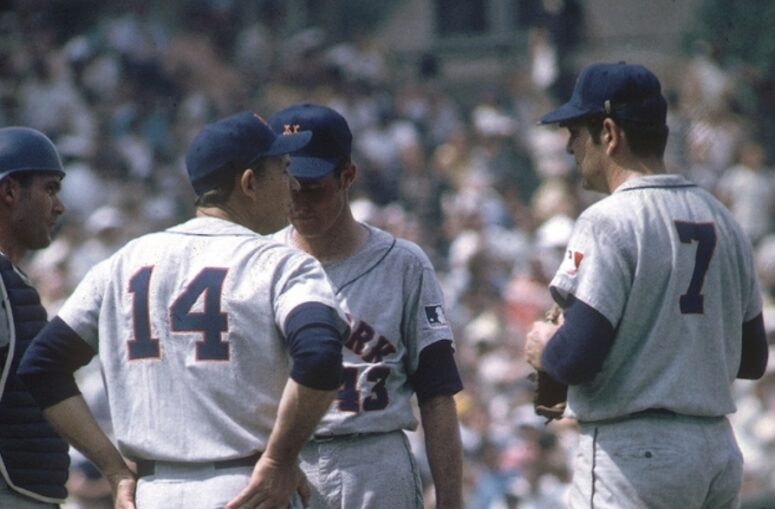
So, speaking of those championships…. the Mets have been celebrating the 50th anniversary of the 1969 Miracle Mets all year long. As this celebration comes to an end, what can you tell us about that ’69 team that hasn’t been said?
What was it like in that clubhouse? Who were the leaders, in addition to Gil Hodges, in that clubhouse?
In the clubhouse we had a couple of older players that were leaders. Donn Clendenon came over from the trade. He was a vocal spokesperson in the clubhouse. He was studying to become a lawyer, he became a lawyer, and he acted like so in the clubhouse.
Ed Charles was an elder statesman, and he lived by design and by his actions on the field, he certainly had leadership qualities. And then we had a great pitching staff. (Author input – you can say that again!) Seaver and Koosman – they never let anything get out of hand and they really controlled the pitching staff.
We had a lot of good players that could play the game. We had good pitching, good defense – that’s the difference between this club and our club. This ballclub this year has lost a lot of game due to errors. We used to lose those games before ’69 then we put them together and we never gave the other team more opportunities or more outs.
That’s the big difference in the ballclub. We had a great defense team. We had a great bullpen. The current Mets have to improve their bullpen, they have to improve their defense, if they want to be a championship team.
One final question and I’ll let you get on with your evening.
At some point late in your Mets tenure, you began a second career as a pinch hitter. From 1974 through 1978 you batted .396 as a pinch hitter, and in 1974 you batted .486 which is still an MLB record.
What was the transition like and were you surprised at how good you were in those pressure situations?
No, I wasn’t surprised because I thought I was a good hitter! I just caught up with the league. I had played for so many years and guys thought I was over the hill but I was in the prime of my career. I should’ve been playing on a consistent basis, but being around so long they expect you to be over the hill.
I was only 34 when I retired after 18 seasons in the major leagues. I could’ve continued to play. There was no reason to retire except the Mets were a bad organization in ’79 and I had already been on a roller coaster twice. I started on the bottom, I went to the top, went to the bottom, went to the top, I was back on the bottom and I didn’t want to take that ride anymore.
So I just chose to retire as opposed to going to the city and continuing because of the economics of the game back then. If it was today, you’d play for another four or five years. You don’t retire when you’re making the kind of dollars players today are getting.
Thanks again for taking some time to talk to us at Metsmerized.