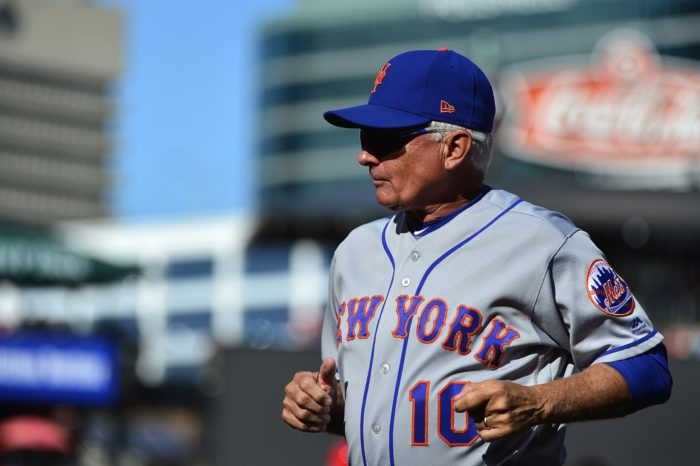
Almost seven years ago to the day, Terry Collins was brought in to see the New York Mets through what would be a long rebuild in the aftermath of the Bernie Madoff scandal and two consecutive losing seasons.
Sandy Alderson appointed the former skipper of the Angels and Astros to mind the store as he stripped down the team his predecessor Omar Minaya left him, from top to bottom.
Collins didn’t turn out to be just a one-term manager, he went on to manage the most games in club history. Only two other managers besides the 68-year-old have reached the 1,000 game plateau: Davey Johnson and Bobby Valentine.
There were many ups and downs during Collins’ time with the Mets, as 2011-14 saw the team finish with losing seasons as their playoff drought bled on. But in 2015, the culture changed.
Collins embraced it. He kept his team in the race until July and when the Mets acquired Yoenis Cespedes, they took off. Things were finally good in Queens. The Mets went to its first World Series since 2000 with high aspirations for the future.
After clinching the Wild Card in 2016 with an injury-riddled team, Collins became just the second Mets manager in team history to lead the team to back-to-back postseason appearances. The other being Bobby Valentine in 1999-00.
A Change of Heart
Prior to his career with the Mets, Collins came under scrutiny as manager of the Astros and Angels, known for being an unapproachable and fiery guy. His most recent stint at the helm before the Mets was in 1999 when he resigned from his position with Anaheim.
He had lost his clubhouse and the players interjected to the general manager when they heard he was set to receive a contract extension. Two days later, with tears welling in his eyes, he resigned.
Collins scouted for a year, coached for a year, managed in Japan for two years and worked in the minor leagues for six years before Alderson offered him the job as Mets manager for the 2011 season.
With New York, he refused to make the same mistakes as he did in Anaheim.
“The main thing is that I took everything that happened on the team to be my fault,” Collins said in 2015. “I took everything personally. If you were Gary DiSarcina and you went 0-for-4, I thought I failed you, and I was [angry]. Unfortunately, back then, I wore my emotions on my sleeve, so you thought I was mad at you.
“So that’s changed here. I still have the same passion. I still want to win. But I’ve learned you can’t let it out. You’ve got to let it go.”
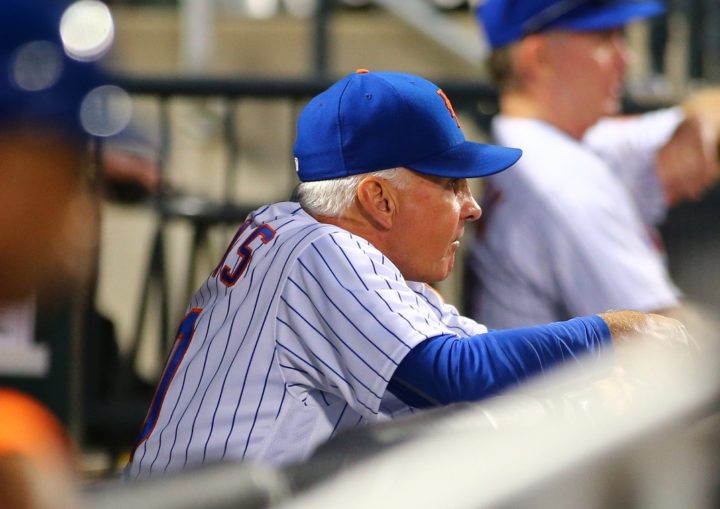
A Sour Send-Off
The Mets have a history of ending things on bad notes with managers and players. No one can forget Willie Randolph being fired at 3 a.m. on the West Coast after a win, or the Midnight Massacre that saw Tom Seaver get shipped away.
If you haven’t read the newspaper the last few days, anonymous front office people and players in the organization lashed out against the Mets manager as his days with the organization was coming to an end.
Players called him unapproachable, the staffers accused him of running his pitchers into the ground, he allegedly went against front office orders when asked to do something in-game. The timing was terrible.
Collins still had a weekend series to manage and with no official word of his future, had to face reporters and deal with the accusations against him.
While David Wright and Jacob deGrom were quick to defend Collins, the situation felt eerily similar to that which got him run out of town in Anaheim. “The inmates ran the asylum,” one player said.
Additionally, Collins was under fire for some of the plethora of injuries the team has dealt with this season, particularly with his handling of the bullpen. “He ran some of those relievers into the ground,” said one team source who attributed Jeurys Familia‘s blood clot to abuse by Collins.
“It’s part of the job,” he said. “You sit here and make decisions that you think are in the best interest. There are a lot of factors involved. We don’t send anybody out to hurt anybody. Never have, never will. The players, training staff, coaches all have input.’’
There was also a notion that Collins lost the clubhouse after the veterans like Curtis Granderson and Jay Bruce were shipped away in trade deadline deals, with a breakdown in communication leading to a fractured clubhouse.
Sandy Alderson dismissed these allegations Saturday and ripped the New York Post and Newsday for the articles, but by then, the damage had been done.
On Sunday, Collins will presumably manage his last game as a Met and be replaced by someone younger. At 68, Collins is the oldest manager in the league. With no plans to retire, as the skipper said earlier last week, he will remain in baseball with the Mets or elsewhere.
“It’s been a lot of fun, and when it’s over, it’s over,” Collins said. “I’ll walk out with my head up. It’s been a great experience. And I’ll tell you, as you know, this is not Riverside, Calif., by any stretch of the imagination. This is an intense place, and second’s never good enough.”

Legacy in a Nutshell
Say what you will about Collins, but he spoke to the media every day for seven seasons and seldom lost his cool. His in-game decisions were questionable at times, but he did mellow out since his time with Anaheim and it showed.
Collins presided over some significant and notable moments during his tenure with the Mets including but not limited to: Jose Reyes winning the franchise’s first batting title, Jacob deGrom’s Rookie of the Year campaign, R.A. Dickey capturing an NL Cy Young award, Johan Santana tossing the first no-hitter in franchise history, and of course guiding the team to its first World Series in 15 years.
Unfortunately, in a season filled with such high expectations for a championship, Collins will go out as the team finishes with the worst record under his leadership.
That said, if this is surely the end, Collins served the team well in his seven years and he is happy with the job he did.
“I listen to it and I respect it, but I’m also at the point where I don’t have to worry about next year,” he said. “I’m 68 years old. When you’re 48, it’s a little different. But I’m at the point now where, look, I don’t have to apologize for anything. I’ve managed around the world, I’ve had great teams, I’ve had good teams, I’ve run minor league systems.
“When I got this job, I said: ‘I’m gonna enjoy it; I’m gonna enjoy it more than I did the other jobs.’ The other jobs were work. The other jobs I thought I had something to prove. I don’t think I had that here. I just said: ‘Look, I’m going to manage this team the best I can, and take what happens.’ ”
With Collins officially stepping down from his role as manager following Sunday’s match with Philadelphia, an era has ended.
While it had its bumpy moments, Collins can look back on a successful time here in New York with a smile on his face. And in the end, he accomplished many milestones which have been highlighted above.
We here at MetsMerized extend a wholehearted thank you to Terry for his service in blue and orange and look forward to what he brings to this organization in his new role.