
As the Winter Meetings approach, we know that the Mets are interested in left-handed smart guy, Craig Breslow. The Yale alum pitched to a staggering 5.96 ERA in Boston last season over 54.1 innings of relief work. Of course, this followed a much more impressive campaign in 2013 when his ERA was a microscopic 1.81 on the season.
The difference between his successful 2013 season, in terms of ERA, and his much more disappointing 2014 performance can be found in the long ball. Using xFIP, which adjusts for a league-average home run rate, we can see that Breslow was pretty much the same pitcher in each of the past two seasons.
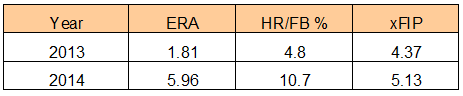
Having pitched most of his career in Oakland and Boston, as a southpaw, Breslow has found the majority of his games in homer-friendly ballparks, particularly against left-handed sluggers, which helps explain his career 6.9% HR/FB rate.
We can look at park factors to see how his home ballparks have helped him. Between 2010-2011, while in Oakland, his xFIP was 4.16 and 4.38, respectively, with his unadjusted ERA (3.01 / 3.29 in 2010 / 2011) improved favorably by those low Oakland HR factors. In 2014, we can see what we already know by picturing Fenway Park with the triangle in center field and the deeper gap in right-center versus the short wall in left.
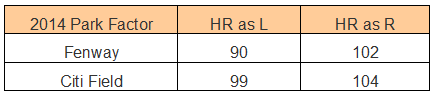
It is harder for a lefty to hit a home run than a righty in Fenway. And in 2014, Breslow surrendered only two of his eight home runs allowed to lefties at home. He served up no such homers in 2013. This from a pitcher who faces lefty and righty hitters, equally. Thus, it’s not hard to imagine that he would have allowed more home runs over the past few seasons had he not pitched half of his games in Fenway.
If Breslow were to sign with the Mets, his protection of a deeper right field would be gone thanks to the new Citi Field dimensions.
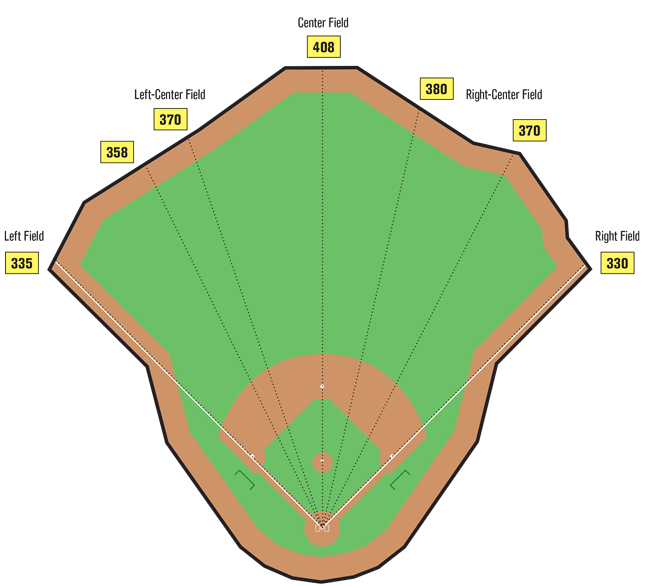 We can imagine that Citi Field’s park factor for HR as L will increase in 2015.
What this means is that while the Mets are looking for a lefty reliever who can pitch to hitters who stand on both sides of the plate, which Breslow does, they would be putting their faith in the assumption that Breslow’s 2013 performance is more realistic than his 2014 disaster based on an “inflated” HR/FB rate.
This is a difficult assumption to make given that Breslow’s HR/FB rate ballooned in a ballpark where left-handed hitters have difficulty finding power. Put Breslow in Citi Field next season, and the likelihood of him falling victim to the long ball only increases given the new dimensions.
Craig Breslow is essentially a replacement-level reliever (-0.6 fWAR in 2014). His ERA was impressive in 2013, and one could look at his increased HR/FB rate in 2014 to decide that it was an anomaly given his career totals. But we know better than that. We know that he pitched for much of his career in Oakland where home runs go to die, and then Fenway, where match-ups against lefties gained advantage due to the deeper parts of right field.
Again, Breslow was essentially the same mediocre pitcher in 2013 as he was in 2014, if we look at his numbers using a league-average home run rate.
If Breslow’s peripherals maintain in 2015 (career 7.22 K/9, 3.65 BB/9) and his HR/FB rate remains high, he is surely a pitcher the Mets can live without.
*Statistics courtesy of FanGraphs and Baseball Savant.