Credit: Andy Marlin-USA TODAY Sports
The New York Mets’ inconsistent play continued into the second series of the year as they split two games with the Miami Marlins, with Sunday’s finale suspended due to rain and rescheduled for August 31.
The home opener ended with controversy, and the second game was riddled with frustration, so let’s get into the ups and downs of the two games.
3 Up
Jacob deGrom‘s Pitch Selection
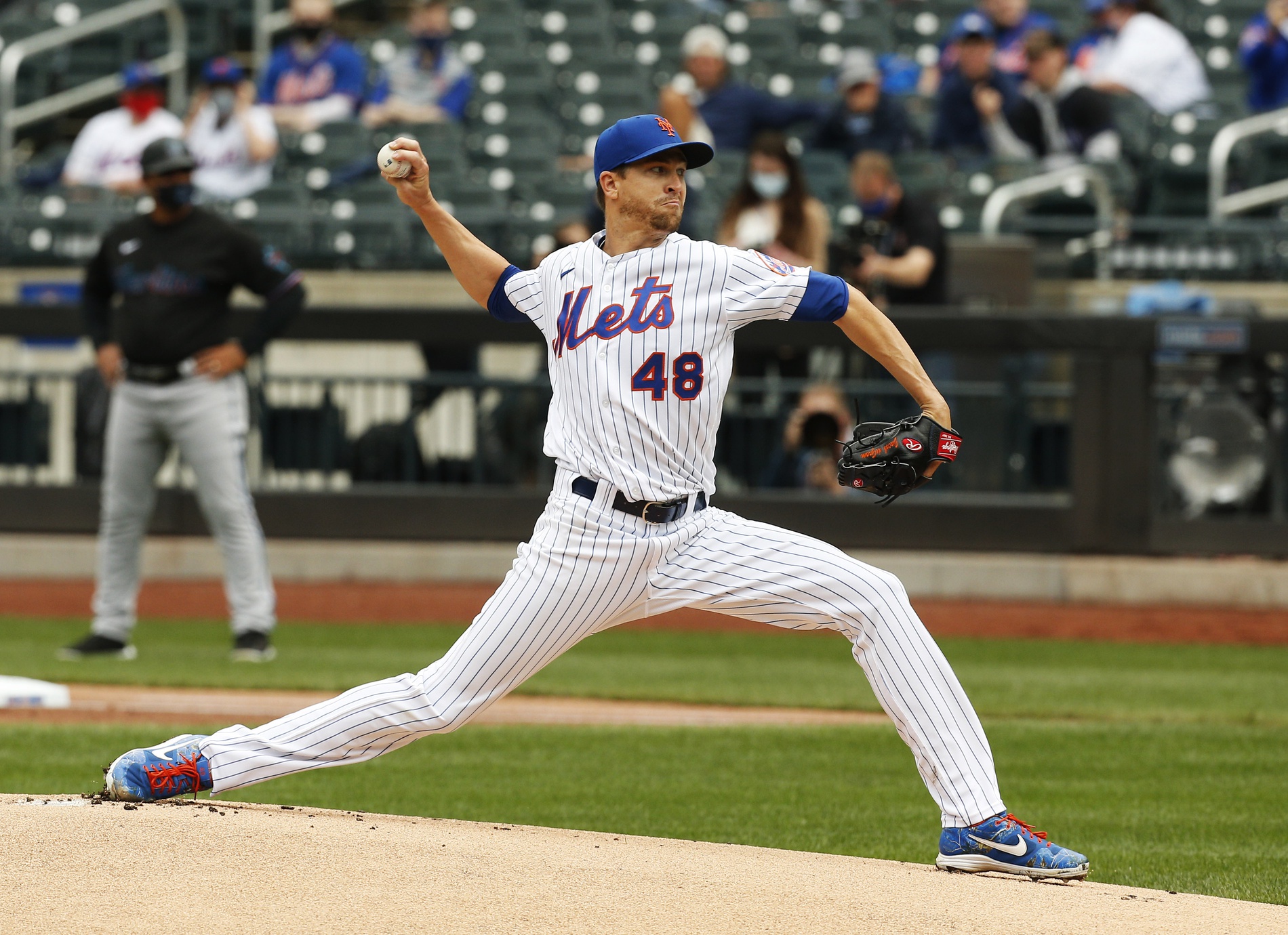
Jacob deGrom, the best pitcher in the world, is locked in.
The talk of his first two starts has been his about his fastball, and deservedly so. It’s gained velocity every year he’s been in the big leagues and now sits at 99.1 miles per hour — 0.5 mph faster than 2020. The pitch also got the same amount of vertical break as it had in 2020, giving deGrom a faster fastball with the same appearance that the pitch is “rising” — or, not breaking — as it was in 2020, as well.
Once one of the most dominant fastballs in the game is established, that allows deGrom to do whatever he wants with his secondary pitches. So far in 2021, he’ll pick one that he’s feeling and ride it to contrast his fastball all game. Here are his pitch breakdowns so far in 2021:
Start 1: 59 fastballs (77 percent), 18 sliders (23 percent)
Start 2: 68 fastballs (72 percent), 21 changeups (22 percent), 6 sliders (six percent)
That’s all fastballs and sliders in start one, and 94 percent fastballs and changeups in start two. His fastball usage has spiked from 44.9 percent in 2020 to 73.8 percent in 2021. He hasn’t thrown a single curveball yet this year after averaging two or three a game in previous seasons.
That’s how dominant deGrom is at this point. He can take his two best pitches of the day, sit on those for nearly 100 pitches, and end up with 14 strikeouts, a couple of hits and no walks over eight innings.
His total line for the year so far: 14 IP, 1 ER, 8 H, 2 BB, 21 K, 172 pitches.
The runs will come. (I hope.)
Pete Alonso‘s Exit Velocity & Chase Rate
Here’s one of those small sample size things, but Pete Alonso is seeing pitches well and absolutely mashing the ball to start the year.
Alonso is chasing the ball way less than previous years so far — his chase rate is currently in the 93rd percentile in all of baseball. (He was around the lower third in baseball with his chase rate in 2019 and 2020.) His plate discipline stood out during spring training, as he wasn’t chasing as many sliders outside and fastballs up above the zone, and that’s carried over to the regular season.
Among players with at least 10 batted ball events (BBE) according to Statcast, Big Pete is fifth in the majors at an average of 98.1 mph on his batted balls, too. He’s behind guys like Juan Soto, Manny Machado and Aaron Judge, which is completely fine and normal. He’s also behind Wilson Ramos — yes, The Buffalo — who currently leads baseball with an average exit velocity of 104.3 mph.
So yes, small sample size, but it’s nice to see Alonso in the 99th percentile of average exit velocity as the year gets underway.
James McCann‘s Pickoff
While his offense hasn’t shown anything to start the year, James McCann did something from behind the plate no Mets catcher had done in over a decade.
Well here's something we haven't seen much of from Mets catchers in recent years. Nice snap throw from James McCann to pick off Chad Wallach. McCann hit 79 mph on the throw. pic.twitter.com/QeZZIvFSkV
— Anthony DiComo (@AnthonyDiComo) April 10, 2021
McCann’s pickoff at second base on Saturday was the first time a Mets catcher picked a runner off at second base since 2008, per the SNY broadcast.
McCann’s framing numbers — specifically from balls down in the zone, which Ramos struggled with mightily over his two years as a Met — have shown improvements from previous starting backstops for the Mets, too. Now, let’s just get that bat working.

Mandatory Credit: Jasen Vinlove-USA TODAY Sports
3 Down
The Offense
Okay, the offense has just been plain bad so far. They’ve scored 16 runs in five games, with half of them coming Tuesday night in Philadelphia. However, there’s probably one culprit for this, one that if I asked you in 2020, you’d probably say the same answer: how they’ve performed with runners in scoring position.
Mind you, this is a team issue.
As a team, they’re second-to-last in the majors with a .146 batting average with runners in scoring position. Here are the numbers so far for Mets batters in this specific situation:
- Francisco Lindor: 0-2, three walks
- Michael Conforto: 2-10
- Pete Alonso: 1-7, two walks
- Dominic Smith: 0-3
- James McCann: 1-3, one walk
- Leadoff hitter Brandon Nimmo: 1-1, two walks
Those six men have combined for eight RBI in situations with runners in scoring position. Conforto has three, and the rest each have one.
The Mets are averaging four runners left in scoring position per game, which is 26th in the league, tied with Tampa Bay and a notch above the Phillies and Dodgers. All three of those teams, though, have normal batting averages with runners in scoring position (around .250-.260) and are averaging close to a run per game or more than New York. The Mets are also leaving nine men on base total per game, with only the Dodgers leaving more on base (who, again, are scoring six runs per game already).
All in all, no team is leaving as many men on base and performing as poorly as the Mets are when men are in scoring position. If that’s what your eye test told you, you were right.
The team’s batting average with balls in play is about league average, and so is their wRC+, according to FanGraphs. Given the high-powered capabilities of the Mets offense, all of these numbers — BABIP, BA w/ RISP, etc. — will probably improve. Part of this can be chalked up to scheduling inconsistency. By the end of the Marlins series, the Mets were scheduled for nine games in 11 days. They’ve only played five. It’s hard for guys to get in any sort of a groove when playing what feels like every other day.
The Mets are about to play four at home against the Phillies, then three more in Colorado. We’ll check back in on these numbers a week from now.
Umpiring (and Other Decision Making)
This was a bad series from Ron Kulpa and the crew.
The Mets were gifted a win by Kulpa when he called a hit by pitch on a strike inside the zone that nicked Michael Conforto‘s elbow pad as he “turned away” from the pitch. Though we all like to think Alonso would’ve come up next and ended the game anyway, there’s no denying the game shouldn’t have ended there, and that’s on the umpires.
Then came Sunday’s weather debacle. Once the game started, it took seven minutes of steady rain (and plenty of it beforehand) for the umpires to finally call a rain delay, then another two-and-a-half hours before suspending the game. Marcus Stroman, Jesus Aguilar and other players were all visibly frustrated this game even started, and Stroman and Aguilar were making it clear they didn’t want to be playing in the weather (for good reason) before the tarp was brought on the field after nine pitches.
In the world of COVID-19, where Major League Baseball claims it wants to limit teams being at the ballpark for unnecessary time, it brought 50-plus players to a rain-soaked Citi Field for nine pitches, ultimately choosing to push the game to a double-header in August.
Luis Rojas said after the suspension the decision to start the Sunday game was a “collaborative effort” between the front office, the ballpark operations crew, himself and weather “sources” who have more “expertise” on the topic of rain patterns. According to Rojas, the consultants said they should’ve been able to play through Sunday with on-and-off light rain. That wasn’t the case, and now the Mets will have to wait and see if they burned their no. 2 starter for another five days all for nine pitches.
DFA’ing Franklyn Kilomé
Farmhand Franklyn Kilomé was designated for assignment Saturday when the Mets placed J.D. Davis on the injured list. It was confusing to see the 25-year-old, who was acquired from the Phillies for Asdrúbal Cabrera in 2018, placed on waivers to free a 40-man roster spot for José Peraza, who will most likely sit at the end of the Mets’ bench for the next five or six games (Davis can come off the IL Saturday).
Kilomé pitched 11.1 innings in 2020 after sitting out all 2019 following Tommy John surgery. Though results weren’t great in those handful of innings, they were his only innings thrown since the end of the 2018 season. We could argue the other roster moves done to make sure Kilomé safely remained in the organization. It was nevertheless an odd move to make for a team open about lacking upper minors pitching depth not too long ago.
If he returns to the organization after clearing waivers, Kilomé, who was one of the top prospects in the system after trading for him, probably won’t see the majors for the Mets this year unless he blows people out of the water once the Triple-A season gets underway.