
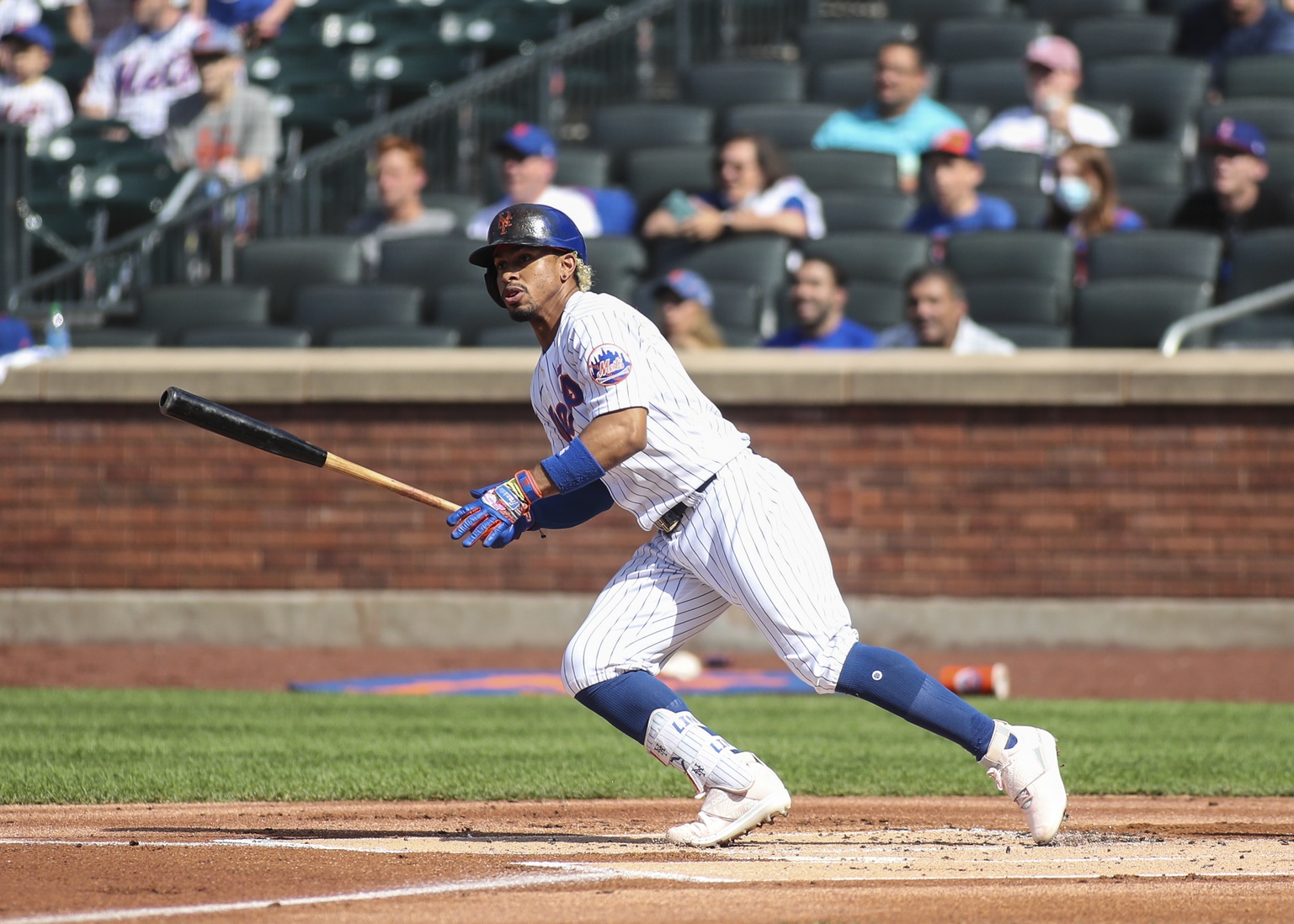
Mandatory Credit: Wendell Cruz-USA TODAY Sports
The Mets ended the first half of the season with a disappointing series split against the Pirates, one of the worst teams in baseball. In our attempt to be optimistic when possible, the Mets still enter the break in first place in the NL East with a 47-40 record and a 3.5-game lead over the Phillies. It’s their best first half in a decade record-wise, but you still feel the Mets could’ve performed even better. That’s true over the first 87 games, and it held true in the four games against Pittsburgh.
I’m going to recap general first half trends in a separate 3 Up, 3 Down, but for now, let’s get into current trends highlighted in the Pirates series.
3 Up
Lindor Ends The First Half Strong
Francisco Lindor hit himself a couple of dingers this weekend, including a huge grand slam Friday that officially busted that game open. They were a nice stamp to end what’s been a solid last month-and-a-half for the shortstop.
Lindor’s average was hovering around .200 for most of May, but he had a .241 average and .765 OPS across Junev–va marked improvement from his first two months as a Met. With a 5-for-13 series against the Pirates, he’s now hitting .333 with a 1.015 OPS in July’s 11 games. His season average is now comfortably above the Mendoza line, and his OPS sits at .703 — the first time his OPS has been above .700 all season.
Lindor spoke after the game Friday about how badly he wants to contribute offensively, which is why he took a slow trot and smiled when rounding the bases after his grand slam. He said he was listening out for boos, not in a way that came off as snarky, but as an affirmation that his offensive success would tamper them.
He still leads in the Mets’ position players in fWAR largely off the strength of his defensive abilities, but he’s showing he’s returning to complete form just in time for the second half.
Boom-or-Bust Big Pete
After a 3-for-4 game against the Phillies on June 27, Pete Alonso has just 10 hits in his last 50 at-bats, good for a .200 average. Six of those 10 hits are home runs, though, so his OPS over that time clears .960. In fact, he has a 158 wRC+ over the last 14 days — the best on the team. Exclude his 5-for-7 on June 27 and 28, though, and he’s just 8-for-47 in his last 13 games. His OPS drops to just over .700 in that time.
This is partly an exercise in picking sample sizes, but also a general observation that Pete has been real boom-or-bust when he’s connected with the ball over the last couple of weeks (though he’s not quite as Yasmani Grandal levels of boom-or-bust when hitting the ball).
I couldn’t decide if this trend was a good or not-so-good one, but with guys like Brandon Nimmo and Lindor actually getting on base ahead of Pete, the booming homers are totally worth it with 13 RBI over that span. Either way, it’s probably a decent sign for his chances in Monday’s Home Run Derby.
Taijuan Walker, the All Star
With Jacob deGrom opting not to pitch in the All-Star game in the name of rest, Taijuan Walker will replace him.
He earned his spot with 16 solid starts, pitching into the sixth inning or beyond in half of them. Even in starts like Friday, where Walker wasn’t his sharpest (five innings, two earned runs), he’s been able to limit damage all year. He’s allowed more than two earned runs in just two starts. The 28-year-old has the eighth-best ERA in the National League heading into the break at 2.50 (3.94 xFIP, 3.83 xERA), and he’s also boosted his strikeout percentage to a career-high 24.9 percent.
He’s done this off the strength of having one of the best fastballs in baseball. He throws it just over 31 percent of the time, and batters have .169 batting average, sixth among pitchers with 100 plate appearances ending in a fastball, against the pitch. His sinker, which acts as a two-seamer and sits around a similar velocity as his four-seem fastball, has been extremely effective, as well, ranking eighth among qualified starters in batting average against. He’s top 15 in weighted on-base average with both pitches, too.
Walker hasn’t thrown this much in a season since 2017. In fact, he surpassed his total starts from 2018 to 2020 with his start Friday, so the Mets are going to have to take it a little easier with Walker in the second half with regards to his workload. (They were cognizant of it last week when they gave Walker a couple of extra days rest before starting him against the Yankees.) That shouldn’t be an issue, though, with Carlos Carrasco set to return by the end of July, and acting general manger Zack Scott emphasizing bolstering the rotation at the deadline.
And that leads to…

Mandatory Credit: Geoff Burke-USA TODAY Sports
3 Down
The Mets Need a Starter
The Mets’ top three starters — deGrom, Walker and Marcus Stroman — have carried the team deep into games over the first half, but their lack of consistent fourth and fifth guys have started to show recently.
This weekend against the Pirates, Tylor Megill and Jerad Eickhoff, who was supposed to be their long man after they used an opener Sunday, combined to throw 5 1/3 innings. That’s not good enough. Though he’s shown signs of an ability to stick around, Megill needs to start getting deeper into games — something he’ll likely work on when he gets sent back down to the minors later in the year. (Eickhoff will likely be designated for assignment before their next game.)
The team still has one of the better bullpens in baseball, especially when you focus on their top four or five guys, but when they’re taking on five innings a game two out of every five games, it starts to catch up to you as a staff. Met relievers were top 10 in the majors in ERA during April and May, but they’ve fallen to 17th in both June and July.
The Mets’ goal for the first couple of weeks out of the break will be to acquire a trustworthy starter in the trade market who can go five or six innings each time out. David Peterson was showing signs of being able to get deeper into games before his injury, but he’ll be out until at least August. Carrasco may be back with the team soon, but Rojas said he may get called up without being fully stretched out, simply because they need competent starters who’ll eventually get to throwing six innings a game.
The Mets Can’t Hit A Lefty Starter
Saturday in Game 1 of the doubleheader, the Mets faced Tyler Anderson, an average southpaw, and scored two runs in five innings off him. It felt like another unimpressive outing against a lefty after guys like Jon Lester, Max Fried, Nestor Cortes Jr. and Brett Anderson handled the Mets with relative ease recently.
Overall, the team ranks 22nd in OPS and 16th in wRC+ against left handers, which isn’t too bad. When you look into what they’ve done against starters, though, the Mets drop to the worst offense in the league against lefties. (They’re 9-16 in games a left-hander starts.)
Through the first six innings of a game against lefties, the Mets have a 73 wRC+ and .603 OPS — both last in the majors. Flip that to the seventh inning and later? The Mets have a 156 wRC+ and .939 OPS — both the best in the league. This tracks, too, with recent comebacks against the like of Aroldis Chapman, Josh Hader and Will Smith.
The cream of the National League crop aren’t littered with lefties, but the Mets will come out of the break facing the Pirates (with Anderson), Reds (Wade Miley), Blue Jays (whose top two starters, Robbie Ray and Hyun-jin Ryu) and Braves (Fried) all have strong lefties. We’ll see if the offense will continue to sputter.
Not Beating Up Bad Teams
Despite the Mets being first place for over two months, their first half still feels a little underwhelming in the fact that you feel they could lead the division by double the games they do. This was highlighted in just a split of this Pirates series, rather than what could’ve easily been a 3-1 series win.
No other team in the division is over .500, and they’re just 19-18 against NL East teams. It’s a trend that matches against bad teams across the rest of the league, with just a 31-25 record against teams under .500. That winning percentage (.554) ranks 20th in the majors against teams with a losing record.
Four other division leaders rank in the top 10 in winning percentage against teams under .500, and only the Houston Astros at 13-14 rank lower than the Mets. (The Astros’ 42-22 record against teams at or over .500 has kept them in the lead in the AL West, though.)
We’ve been saying it for probably two months now, but the Mets could really expand the division lead by the end of July with three more games against the Pirates, five games against the Braves, and another eight against the Reds and Blue Jays, who’ve floated just above .500 for the last couple of months.