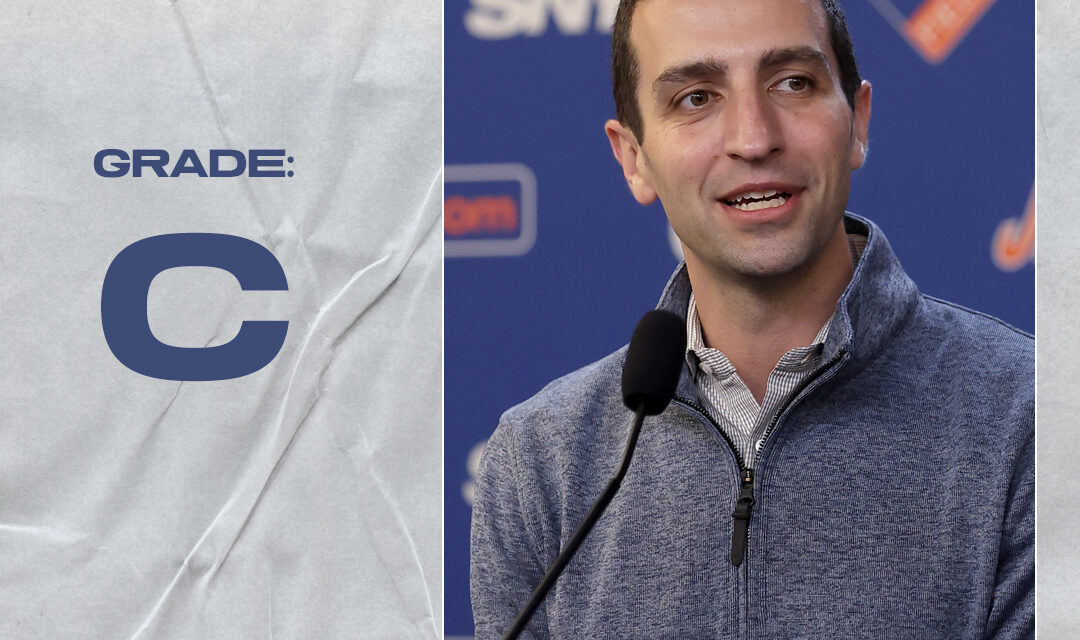
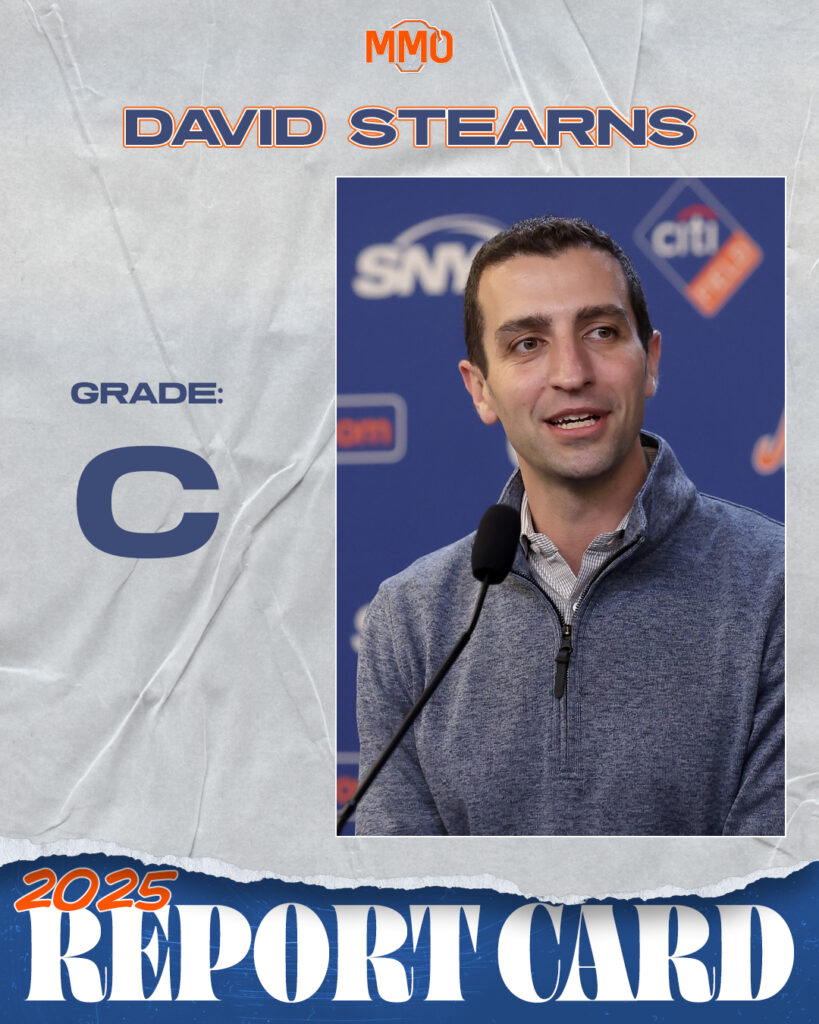
GRADE: C
2024 REVIEW
“I’m the architect of the team and I’m responsible for it.”
David Stearns did not mince words when taking the blame for the Mets’ disappointing 2025 season. After rightfully getting so much credit for the Mets’ magical run to the NLCS in 2024, Stearns learned how things can change in a New York minute. While injuries and underperformance were certainly factors in 2025, the Mets’ chief architect is responsible for building a roster that failed to make the playoffs despite being the most expensive in baseball.
The (Pretty) Good
After mostly shopping the bargain bin the year before with great success, Stearns benefited from Steve Cohen’s willingness to let him spend big money heading into the 2025 season. And spend he did. Stearns was able to lure Juan Soto across town with the largest contract in professional sports history (15 years, $765 million), and waited out the Pete Alonso market to eventually re-sign the first baseman and fan-favorite (two years, $54 million with a player option). Both players earned their hefty paychecks; Soto provided an MVP-caliber offensive season despite a slow start, while Alonso re-emerged as an elite power source after a subpar 2024 season.
Anchored by the Soto and Alonso signings, to go along with Francisco Lindor and Brandon Nimmo, Stearns constructed a fearsome if inconsistent lineup that often carried the Mets. The team ranked in the top third of the league in most offensive counting stat categories, including ninth in total runs scored and fourth in OPS+. But the lineup did have a couple of fatal flaws, including a lack of situational hitting and an inability to come through in the clutch. The Mets were the only team in baseball without a win when trailing after eight innings, going an astonishing 0-70 in such situations.
The Bad
Stearns put together a fragile and ineffective rotation that couldn’t hold up over the long season, which was the main culprit for the Mets’ collapse. He upheld his philosophy of avoiding long-term contracts for starters, thus staying away from free agent aces like Max Fried and Blake Snell. Instead, Stearns attempted to build rotation depth with lower-tier free agents, including career-reliever Clay Holmes (three years, $38 million), plus Frankie Montas (two years, $34 million) and Griffin Canning (one year, $4.25 million), both of whom were coming off awful years. Stearns also re-signed Sean Manaea to a three-year, $75 million contract after an awesome 2024 season with the Mets.
Holmes made a fairly successful transition from reliever to starter, and Canning was solid before rupturing his Achilles tendon in June. But Montas had a miserable year marked by injury and ineffectiveness, and Manaea suffered a similar fate.
The individual outcomes of Stearns’s rotation moves were mixed, but the end result was a collection of pitchers that rarely made it past five innings, putting a heavy burden on the bullpen. The second half demise of David Peterson and Kodai Senga certainly didn’t help Stearns’s cause on that front.
The Ugly
If Stearns’s 2025 season is remembered for anything other than the Soto signing, it will probably be his disastrous trade deadline. Again, this was not all his fault, although he did ignore adding to a rotation that was falling apart. His trade deadline acquisitions of three good relievers in Gregory Soto, Tyler Rogers and Ryan Helsley were praised at the time, even if his trade for center fielder Cedric Mullins was not. But baseball is a results-driven business, and the results of these moves by Stearns were putrid, largely thanks to the usually reliable Helsley turning into one of the worst relievers in baseball.
2026 Overview
David Stearns has several crucial decisions to make as the Mets try to return to legitimate contention in 2026. Bringing back Pete Alonso and Edwin Díaz should be a priority, but they will both command top dollar. How hard will Stearns go after them, and how will he pivot if either leaves?
The rotation badly needs an upgrade, even if Stearns trusts Nolan McLean to take a leap and Senga, Peterson and Manaea to return to form. Will he pursue a top-tier free agent starter like Framber Valdez? Would he be willing to trade several top prospects for young stud Tarik Skubal – or maybe fewer for someone like Freddy Peralta?
With the Winter Meetings coming up, we’ll start to get a sense of what Stearns is thinking heading into 2026. But it seems that pitching and defense are at the top of his agenda.
“I think we have to be open to everything,” said Stearns. “My continued emphasis is doing everything we can to support our development infrastructure and developing starting pitchers. Ultimately, that is where we’re going to have sustained success and get the organization to a consistently good spot from a run-prevention perspective. But going into this offseason, I’m not going to take anything off the table.”