6
2012
2012 Mets Report Cards: Infielders
The Mets infield faced many questions coming into the 2012 season. Will David Wright re-gain superstar status? Can Daniel Murphy survive as an everyday second baseman? How much will the Mets miss Jose Reyes?
Let’s see how these questions were answered this season….
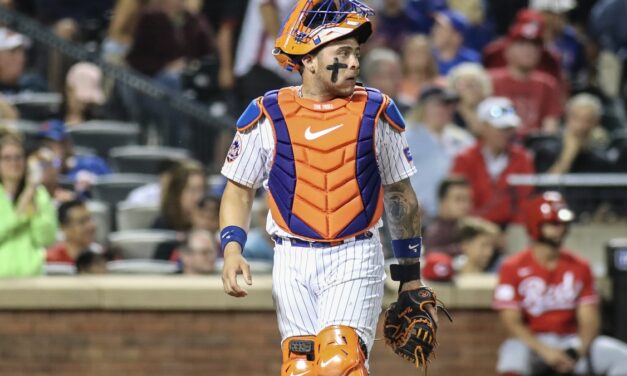
Josh Thole: D-

Josh Thole has not become the player we thought he could be. After hitting over .300 in his last two minor league seasons, and showing glimpses of a future .300 hitter over his first two years in the big leagues, his production has declined. This year, he hit rock bottom.
Thole got off to a great start in April, hitting .317 over his first 21 games. He was getting on base at a .403 clip. Then, disaster struck. On May 7, Thole collided with Ty Wigginton at home plate. The play left him with a concussion, one that sidelined him for almost three weeks. After the concussion, he was a whole new player.
After returning to the lineup on June 1, Thole struggled. He hit just .217 over his final 78 games to go along with his dreadful .536 OPS. I wonder what effect the concussion had on Thole the rest of the season. He told the Star-Ledger a week after he suffered the concussion that it was his fourth. That many concussions takes a toll on a person, and they have been known to cut careers short. Hopefully this doesn’t change Thole for good but I’m very afraid it might.
Ike Davis: B-
We saw two completely different versions of Ike Davis this season. The first two months, Ike weas one of the worst hitters in the league, batting just .170 with a .524 OPS. He was striking out so much and was so ineffective against left-handed pitching that many Mets fans were calling for Ike to be demoted to Triple-A. The Mets decided to stick with him, however, and it paid off.
Davis started to show signs of life towards the end of May, and really picked up his production in June. He hit .264 in June, raising his average more than 30 points and getting his season back on track.
After June 1, Davis’ power numbers shot up as well. He started to drive the ball again, hitting 27 home runs over the final four months compared to five in the first two. He also hit 21 of his 26 doubles from June on. Here’s a look at the rise in Davis’ slugging percentage:
One area that Davis has to improve on next season is his approach again left-handers. In 2010, Davis’ rookie year, he hit .295 against lefties, 41 points higher than his average against righties. The last two seasons, however, his production against lefties has dropped off a cliff. This year, he hit just .174 against left-handed pitching. His strikeout rate rose dramatically and his walk rate was cut in half compared to when he faced righties. Something has to change here if Ike is to be the everyday first baseman.
Daniel Murphy: C
This season was a bit of a disappointment for Daniel Murphy. In 2011, he hit .320 in 109 games before having his season abruptly cut short after suffering a torn MCL. This year was going to be his big chance at second base and to prove that his bat can make up for any defensive woes.

Coming into this year, I really thought the Mets had a future .300 hitter in Murphy. He had shown flashes of being a gap-to-gap doubles hitter with 10-15 home run power and an batting average that would sit above, if not well above, .300. This year, he had a solid .291 batting average, but his walk and power numbers decreased. His power numbers were especially disappointing.
With the glove, Murphy started off horribly but improved slightly as the season went along. One thing that I’ve noticed from Murphy this season is his ability to make big plays. However, he also has a tendency to botch the routine ones and because of that, he is still a below-average second baseman.
Murphy certainly didn’t do enough to lock up the second base job, but will likely be the starter next season because the front office has bigger issues to address.
Ruben Tejada: C+
This season was a small step backward for Ruben Tejada. In his first seaon as an everyday player, Tejada didn’t improve his offensive numbers. After hitting .284 in 96 games last season, he hit in that same range again (.289) in 114 games played.
One glaring negative with Tejada this year was his drop in on-base percentage. Last year, it was .360 and this year it dropped 27 points to .333. He wasn’t walking nearly as much this season, which caused the drop. In 2011, he had a walk rate of about 9.3%, about one and a half percent above league average. This season, however, it dropped to 5.4%, well below the MLB average.Fans were marveling at his patience and ability to extend an at-bat, but this season, those drawn-out at-bats weren’t leading to as many walks.
A positive sign from Tejada, however, is his uptick in extra base-hits. Last year, he went 23.5 plate appearances between extra base-hits. That number this season dropped to 18.5. He was definitely driving the ball a little bit more than last season.
One thing that we have to remember when looking at Tejada’s season is his age. He turned 23 just last week and definitely performed better than most players his age would. I don’t want to rush to judgement on Tejada because he’s just so young.
David Wright: B

David had a first half for the record books. Coming off a few sub-par seasons, Wright had to prove that he is still one of the best third basemen in the game.
Wright had an excellent first half of the season, hitting a mind-boggling .351 with a .441 on-base percentage. In the first half, he had a walk rate of 14.0%, six points higher than league average and three points higher than his career average. He also saw his strikeout rate plummet to 13.2% in the first half. Take a look at how that compares to the rest of his career:
In the second half, however, we saw the David Wright of old. His strikeout rate went back up (20.7%) and his batting average went down. Wright hit just .258 over the second half, bringing his overall average down to .306.
The second half has me a little concerned about which Wright we will see going forward. It would be a big risk giving David $130 to $140 million going off his first half alone.He showed glimpses of the 2006-2008 David Wright in April, May, and June but which David Wright we will see in 2013 and beyond is still not clear.
Overall: C+
Obviously the starting pitching is the Mets’ biggest strength, but the infield is definitely their second-best unit. The infield already has a proven star in David Wright, and a developing star in Ike Davis. Davis has so much raw power and could eventually hit 40 home runs. The middle infield has potential as well with Tejada and Murphy, both of whom could hit .300 someday. The only troubling area in the infield is the catching position. Josh Thole proved this year that he is not an everyday catcher. The front office really needs to address that area of the team this winter.
About the Author: Connor O'Brien
I am a very young, but passionate Mets fan who has blogged about the Mets for three years. I hope you all enjoy the unique perspective that a fan like me can bring to the table. More about me... favorite Met- Johan Santana... favorite food- Citi Field burgers and hot dogs!... favorite musician- Mos Def... favorite Mets moment- the no-hitter of course, but I also attended Game 1 of the 2006 NLDS as well as Johan's three-hit shutout in late September 2008. Follow me on Twitter @UpAlongFirst
20 Comments + Add Comment


Recent Comments
- Justin: on So Where Are All Those Moneyball Players?: Carrasco, Buchholz, Paulino, Boyer, Rauch, Capuano, Torres,...
- Major Mofongo: on Mets Need More Time To Get Better Understanding Of Ike Davis?: did JV's dad interfere with Dan Hudgens...
- Major Mofongo: on So Where Are All Those Moneyball Players?: moneyball players like... Jose Valentin ...? Endy Chavez....? Duaner Sanchez....? Fernando...
- Hawk: on 3 Up & 3 Down: The Bar Is Now Open Edition: Three GMs and not one good decision...
- Russell Zanca: on 3 Up & 3 Down: The Bar Is Now Open Edition: Wood alcohol!

An article by


SP B-
Infield C+ ( Note 1)
Outfield D (Note 2)
Bench(Hairston Valdy) C+ (Note 2)
Bullpen D
Overall a forth place team with mid 70 wins
Note 1: This rating includes D- for catcher and therefore overstated
Note 2 A comparable to Hairston must be replaced or rating dropped
Power C-
Speed D
Defense C- (Note)
Team Leader D
Spit and Fire (Turner and Murph) C-
Manager C at best
Even with Wright and Ike
Unfortunately I don’t see the dynamic changing much this coming season. You’ve already lost a significant amount of power with the departure of Hairston, they seem loathe to trade Wright and/or Dickey to replenish the roster and give them financial flexibility. We’ve been told again and again there is no money for FAs, so you’re going into the season with what you had last year plus a few Filene’s basement bargains looking to reestablish themselves (like Grady Sizemore, for example).
See you in 2014. Of course, we were told when Perez and Castillo’s money were off the books there would be room to make personnel moves. It didn’t happen. Now we’re being told when Santana and Bay are off the books there will be money to spend…and there will. Fred and Jeff have bills to pay. Yacht club dues keep going up. Oh, you thought they’d spend it on the ROSTER?
Usually when I see these types of report card posts I almost always disagree with them, but I must admit you did a very fair job here in your assessment. It’s certainly beats the few of these they did at Bleacher Report where Wright got an A or A+ and no mention off his horrid second half. I thought you were very fair with Ike Davis too.
I disagree with on Wright. You have to grade his overall body of work for the year. He batted .306, 21 home runs, 41 doubles, 95 RBI, 93 R, 15 stolen bases, and you call that a B? I call it an A- at worst.
Look at it this way. An A+ in the first half plus a C- in the second half, equals a B overall.
Yup
Nah, totally disagree. B+ at the worst, more like an A-.
This. 143 OPS+. And a 7.8 WAR. That’s A work….A- if you want to penalize the down points.
If Wright’s year is only worth a B, others need to be dropped some
Connor you are a tough guy for a 15 year old in marking players. Most other writers gave all the infield higher marks. Murphy a B, and Tejada a B. Wright a A-. But beauty is in the eye of the beholder, so you have your ideas for the players & how they did. I think you could have said that Murphy was doing better in the 2nd half at defense as this was his 1st full year at 2nd base and he worked hard to succeed.
Yeah. I wrote that in the original draft ut I guess I deleted it by accident. Yes, he was TERRIBLE in the beginning but did improve a lot in the second half.
2012 End o’ season grades:
Starting pitching – B+ (What more could have been asked for from Dickey, Harvey, and Niese…even Gee showed decent potential)
Bullpen – D- (Parnell showed, yet again, he is nothing more than a middle reliever or mop up guy, they have no closer or setup man.)
Infield – C-/D+ (Wright was solid offensively and gold glove caliber defensively, Ike played well in the field and had a strong offensive second half, Tejada and Murph were weak offensively, and they have no catcher)
Outfield – F+ (Kirk had some promise early, Duda stunk, Bay is a zombie, Torres stinks, Hairston was better than anyone could have imagined)
Bench – B+ (Valdespin and Hairston were superb, Cedeno was good too.)
Manager/Coaching Staff – C (TC made some bad decisions but it’s hard to make chicken salad out of chicken shit…74 wins was about 10 more than I thought they would have in the preseason.)
I wouldnt give Valespin a B+. He was good until the pitchers got his weakness and then was not that great. Murphy & Tejada werent that bad offensively
Sure, they weren’t too bad offensively if you like your #1 and #2 batters to have a combined .332 OBP, a slugging of under .400, and a combined 76 extra base hits…not-to-mention a total of 14 SBs, which means, since they hit for no extra base power, they basically have to go station-to-station on the bases…which, could be the reason why they only accounted for 198 total runs (runs + RBIs – HRs). Yeah…offensively they were really bad…but, hey, they hit for a decent average and didn’t strikeout much.
As for Valdespin off of the bench not being a B+…well, he had 6 pinch hit HRs, including a few game winners, and had a .523 slugging off of the bench in 65 at-bats…that’s B+ worthy for a rookie. As a starter, his slugging was a mere .373…however, I graded him highly based off of his bench play…as I thought I clearly noted.
Thanks for your opinion…feel free to back up your thought with actual facts. Thanks.
Conner your grading is harsh.
A C+ for Tejada? I’m sorry, but that’s way off. He should be at least a B or B-.
Well a B- isn’t way off
I just felt like his sharp drrop in walks and second half slump didn’t earn him a B. Most of his numbers were either the same as last year or slightly lower.
You knew with the way he was playing this year, a slump was coming. I’m willing to bet, if Tejada didn’t make that faceplant down at 1st base and miss a good chunk of time while he was hot early in the year, I think this would be a moot point and his numbers wouldn’t have been lower or the same as last year. While I agree that his long drawn ABs didn’t lead to as much walks, his pitch selection will greatly improve and the walks will increase. Of all the ABs this season, one of the best/my favorite AB from a Met came from Tejada when he made Jonathan Papelbon work in a long drawn AB, which DID lead to a walk (and a few ABs later, a walkoff hit by Wright).
How can you grade Valdespin when the “Genius” Collins kept trotting Bay and Torres out there every day instead of ONCE during the entire season giving Valdespin 3 consecutive starts to try to see if he could get into a hitting groove. It’s tough for veteran players to adjust when they only play sporadically. How is a guy coming off a 17 HR/37 SB season in his first taste of the big leagues going to learn except to play?
(And for the record, his final batting average was better than both Torres’ and significantly better than Bay’s!)
I agree with you on your ratings, the Mets have so have many holes that need to be filled and I believe that there strongest area can be in there young pitchers, remember to get talent you need to give talent no team is going to trade a strong all around player because they feel sorry for us.The Mets do not have a Strawberry in there minor leagues so we either have to trade or go into FA, the Mets are at least two seasons away before they come a contender.