Jul
6
2011

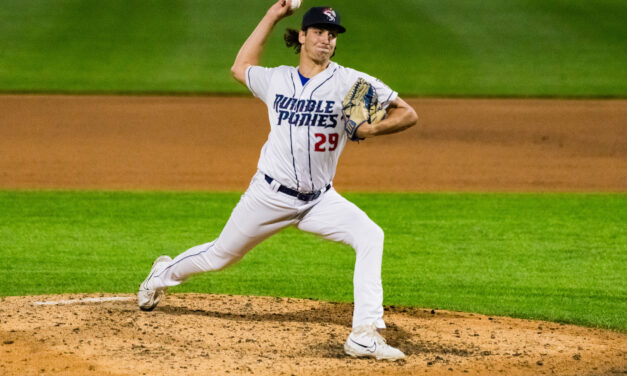
Mets Prospect Spotlight: Chris Schwinden, RHP – Buffalo

Chris Schwinden was drafted first by the Detroit Tigers in 2004 out of high school in the 43th round. He was a draft and follow for the Tigers as he went on to the College of the Sequoias. Schwinden went 5-4 with 1.78 ERA (32 runs/19 earned runs) in 14 appearances (13 starts) with the Sequoias during his freshman season and posted a 15:75 BB:K ratio in 96 innings with 79 hits allowed, but wound up not signing with the Tigers and continued his college career. For his senior season Schwinden transferred the Fresno Pacific University and excelled.

In his only season at Fresno Pacific Schwinden performed like the team’s ace and went 6-1 with a 2.48 ERA (28 runs/25 earned runs) in 13 starts. He threw three complete games and had a total of 90.2 innings in which he allowed just 63 hits and 22 walks, while setting a school record at the time with 96 strikeouts. The Mets took notice and he was drafted for a second time of his career in 2008 when he went in the 22nd round. Being a small school senior sign, he got an extremely small bonus that was barely enough to cover the cost of a wedding ring.

Schwinden was sent to Short-Season A Brooklyn Cyclones for the remainder of the 2008 season and started in the pen, but pitched his way into the rotation and wound up becoming one of the best pitchers on the staff. Among starters his 2.01 ERA was the second lowest just below Brad Holt and his 10.9 K/9 was again second best just behind Holt. He displayed outstanding command and led the team with a 1.7 BB/9 and a 5.83 K/BB.

He opened 2009 in Savannah and was in and out of the rotation until June when he earned a full-time role as a starter. He had a pretty solid season in the Sally, displaying outstanding command once again, but he did not wow anybody. He made 17 starts and posted a 3.28 ERA over 115.1 innings, although he got hit pretty hard. Batters posted a .297 batting average off him with 126 hits and his 88 strikeouts were very mediocre. He got a cup of coffee in St. Lucie at the end of the season and had one good start and one bad start.

Schwinden remained in St. Lucie briefly to open up 2010 before being promoted to Binghamton. While five of his seven appearances in St. Lucie were out of the bullpen he was pitching three to five innings in relief and wound up going 3-0 with a 1.83 ERA. His time in Binghamton was not as pleasant to him. Over 17 appearances (14 starts) he got hit harder than ever before to the tune of a 4-7 record with a 5.56 ERA. His control held up and his K/9 even increased, but he averaged under five innings per start and hitters were even better against him with a .306 batting average against. His BABIP was extremely high at .365 and his FIP was much lower than his ERA at 3.64, yet he remained nothing more than an organizational filler.

He was set to repeat Binghamton in 2011 and made two appearances out of the bullpen, but when Dillon Gee was promoted to fill in for Chris Young Schwinden got a chance to make a spot start for Buffalo. Schwinden was magnificent in that game and struck out nine in five innings, while allowing just a run. Ever since then Schwinden stayed up in Buffalo, remained in the rotation, and has thrived. In late May Schwinden had a 10-day layoff in between starts because the Mets needed him as insurance for R.A. Dickey, and the layoff appeared to affect him for a few starts, but he now looks to be back in form. He is having one of his best seasons at the moment with a 2.87 ERA in 15 starts spanning 87.2 innings and has pretty nice peripherals with a 30:75 BB:K. The walks are up and his BABIP is much lower than his career average, but his FIP is a solid 3.54.

There is every chance that this season is an apparition and his numbers will regress when his stats balance out, but I am not so sure that some of this success isn’t for real. Schwinden has been pitching away from contact more this year than I remember from his days in Buffalo and while his walk rates are up he is still commanding his pitches well.

He works mainly off a 88-91 mph fastball, topping out at 93 mph, that he is able to paint almost always on the black on either side of the plate. The fastball is a little straight for my liking, although he does get some nice arm side run when he elevates it in the zone to get some swings and misses. I have read a bunch of reports that state his changeup is his best secondary offering, but in my opinion the hammer curve is that pitch and his favorite to throw. It comes in mid-to-high 70′s and while at times the pitch can get a bit loopy when he leaves it high in the zone, when it is at its best he keeps it down in the zone and gets a late, hard 12-6 break. His changeup doesn’t get enough separation from his fastball and he leaves it up in the zone far too much to be a plus pitch, but it is still a serviceable third offering. While his slider doesn’t have a lot of break, it has tight movement at 85-87 mph and at times almost functions as a cutter. Although he doesn’t throw the pitch very often, he usually commands it well and keeps it down in the zone. He likes to throw it mostly to the left side of the plate and could benefit from starting it at right-handed hitter’s knees or trying to backdoor lefties.

While Schwinden isn’t the most overpowering pitcher on the planet, I do not like when people refer to him as not having enough “stuff” to get Major League hitters out. He is much like Gee, in that the overall command of his fastball and good off-speed pitch should be enough to keep hitters honest at the next level. In Gee’s case the pitch is a changeup, but for Schwinden it will be good old Uncle Charlie and being a guy who gets a lot of flyballs he could benefit greatly from pitching in Citi Field. He is still just a C prospect, but I don’t think it is out of the realm of possibility for him to have a Gee type of impact at some point this season or next.

Share Button

About the Author: Former Writers

12 Comments + Add Comment

  • can you please explain what is BABIP & FIP?? i am more of a he’s good, he’s average or about wins and losses, ERA, walks and k’s..

    • alex: I’m not a FIP guy so I can’t answer that but BABIP is Batting Average on Balls In Play. Whenever I’ve looked at it, it’s been to spot a “fluke” season. So if a guy has a .310 BABIP year after year and then has a .250 BABIP as a pitcher, he’d been seen as having a lucky year with balls in play.

      I think FIP is essentially what their ERA would be with a league average defense. But I’m not totally sure

      • ohhhh, thanks.. i think is a little be pointless if you asked me. it all comes down to hits allowed, walks allowed, runs allowed.. you know, baseball at its simpliest..

        • The problem with using hits and runs to figure out how good a pitcher is the defense.

          A pitcher with good defense that cover their positions well give up less hits which turns into fewer runs. And you can’t just say “oh well he had a good defense behind him”, you have to actually show it.

          • Everey stat has it’s flaws, like ERA, but the ones that FIP has are SO bad, that it’s useless.

            The most obvious flaw is that it counts every ball hit in play as the same. A line drive in the gap, is the same as a weakly hit ground ball to the second baseman. Actually, it dosen’t “count” either one, it just takes it out completley. One guy gives up line drives, the other guy gives up weakly hit ground balls, FIP dosen’t give credit to the pitcher for getting the batter out by grouding out, and it dosen’t hurt the pitcher if he gives up line drive after line drive.

            The other flaw is that there’s much more to pitching than K’s, BB’s, and HR’s. Hr’s are a big part of FIP, but a pitcher could give up a lot of HR’s and still be really good. Like a Santana. If not many runners get on base, the fact that he gives up a lot of HR’s doesn’t hurt him that much because the HR’s are only solo shots. while another pitcher gives up less HR’s, but they do more damage because there’s more runners on base, so there’s more 2 run and three run HR’s off him because he allows more guys on – More runs scored off that guy obviously, but FIP won’t show you that.

            The same thing goes for walks. A pitcher could give up alot of walks, but still be very effective. Like Gio Gonzlaez.

            And K’s too. Tom Glavine, Roy Halladay with Toronto, Tim Hudson, Jurrjens, and Treavor Cahill.

            The opposite is also true with these stats. A pitcher could not give up alot of HR’s and still be ineffective. Same for walks and K’s.

            So my point is that FIP is judging a pitcher by three stats, that doesn’t always show you if the pitcher is pitching good or bad.

            I know that there’s other stats made up that attempt to “fix” the problems FIP has, but they have serious flaws as well. And the fact that they have to keep making up new ones show that FIP isn’t accurate.

            • “Everey stat has it’s flaws, like ERA, but the ones that FIP has are SO bad, that it’s useless.”

              If this were opposite day, you would right. Seriously, yes, every stat has limitations. Some just have more limitations (ERA) than others (FIP)

              “The most obvious flaw is that it counts every ball hit in play as the same. A line drive in the gap, is the same as a weakly hit ground ball to the second baseman. Actually, it dosen’t “count” either one, it just takes it out completley. One guy gives up line drives, the other guy gives up weakly hit ground balls, FIP dosen’t give credit to the pitcher for getting the batter out by grouding out, and it dosen’t hurt the pitcher if he gives up line drive after line drive. ”

              ERA does the exact same thing. Because once the ball is hit, it is out the pitcher’s scope.

              Besides, how many guys do you know who give up lots of hard line drives also have a low FIP? Remember to consider sample sizes

              “The other flaw is that there’s much more to pitching than K’s, BB’s, and HR’s. Hr’s are a big part of FIP, but a pitcher could give up a lot of HR’s and still be really good. Like a Santana. If not many runners get on base, the fact that he gives up a lot of HR’s doesn’t hurt him that much because the HR’s are only solo shots. while another pitcher gives up less HR’s, but they do more damage because there’s more runners on base, so there’s more 2 run and three run HR’s off him because he allows more guys on – More runs scored off that guy obviously, but FIP won’t show you that.”

              FIP will also show you Santana has a high strike out rate except for last year when he was pitching through an elbow injury.

              “The same thing goes for walks. A pitcher could give up alot of walks, but still be very effective. Like Gio Gonzlaez.”

              If you give up a lot of walks, I have to question your effectiveness.

              “And K’s too. Tom Glavine, Roy Halladay with Toronto, Tim Hudson, Jurrjens, and Treavor Cahill.”

              *Sigh* Tom Glavine has the 8th best FIP of his generation. 2 guys higher than him (Clemens and Brown) have steroid connections, so we can knock them off, making Glavine the 6th best clean pitcher of the 90s. Are you really going to get in a tizzy because Randy Johnson, Pedro Martinez, Greg Maddux, John Smoltz, and Curt Schilling are ahead of him in that category?

              The only active pitchers with a better career FIP than Halladay in his generation are Santana and Oswalt.

              from 2001-2010, Hudson is #11 in FIP. At least 4 guys in front of him are first ballot HoFers.

              Jurrjens and Cahill are still young and developing. They are still figuring out how to turn potential into production.

              “The opposite is also true with these stats. A pitcher could not give up a lot of HR’s and still be ineffective. Same for walks and K’s.”

              What? A pitcher could get a lot of Ks and be ineffective? Like who?

              “So my point is that FIP is judging a pitcher by three stats, that doesn’t always show you if the pitcher is pitching good or bad.”

              Over a large sample size, it in fact does. A lot better than ERA or Ws.

              “I know that there’s other stats made up that attempt to “fix” the problems FIP has, but they have serious flaws as well.”

              Limitations are not flaws. Its when you expect more than what each category is capable of telling you that you run into flaws. But the flaw is with you, not the stat.

              “And the fact that they have to keep making up new ones show that FIP isn’t accurate.”

              Or it means we’re getting a better understanding of how to measure production and FIP works in conjunction with other stats.

              And, if we apply your standard to ERA, we find that it also fails. Miserably.

              • “ERA does the exact same thing. Because once the ball is hit, it is out the pitcher’s scope.”

                The pitcher has a lot of control over how hard(or how soft) the ball is hit. Bad pitchers give up hard hit balls, good pitchers give up softly hit balls

                “If you give up a lot of walks, I have to question your effectiveness.”

                Are you going to tell me that Gio Gonzalez is NOT effective? he was the example I used.

                “*Sigh* Tom Glavine has the 8th best FIP of his generation.”

                *Sigh* Tom Glavine has a career 5.3 k/9. my point about him was the he had a low k/9 and was a great pitcher. k/9 is a major part of FIP, and Glavine proves that you don’t need a high one to be effective – That’s also what the other examples I used prove also. Oh and Ricky Nolasco has a lower career FIP than Glavine, is Nolasco better than Glavine?

                “What? A pitcher could get a lot of Ks and be ineffective? Like who?”

                Maybe not “ineffective” but there’s guys who can get alot of K’s but really don’t know how to pitch, like a Morrow. Or a Ricky Nolasco type who gets K’s but is not really that good. My point is that K’s aren’t a great way to show how good(or bad) the pitcher actually did because you could not get many of them and do good(Glavine) or you can get a good amount of them and be not that good(Nolasco).

                “And, if we apply your standard to ERA, we find that it also fails. Miserably.”

                Nope. You do make a valid point that defense has some affect on it. But here’s why it’s better. it shows how many runs the pitcher gives up, by looking at how many runs the pitcher gives up. Simple. It makes sense, is it 100% accurate? No of course not. But how else can you judge how many runs the pitcher gives up? By taking EVERY ball hit in play? You can’t measure how many runs a pitcher gives up by taking out every ball hit in play because the pitcher does have control over how hard(or soft) the ball is hit. and there’s a lot more to pitching than HR’s K’s and BB’s, so you can’t measure it by that either.

                There’s just so many problems with FIP, that it just can’t be used to judge pitchers. The only problem with ERA is the defense part, but if your a smart baseball fan, you would know the good and bad fielding teams around the league and you realize that when you’re judging pitchers.

                • “The pitcher has a lot of control over how hard(or how soft) the ball is hit. Bad pitchers give up hard hit balls, good pitchers give up softly hit balls”

                  That they don’t field

                  “Are you going to tell me that Gio Gonzalez is NOT effective? he was the example I used.”

                  Again, another guy making the potential to production transition.

                  “Oh and Ricky Nolasco has a lower career FIP than Glavine, is Nolasco better than Glavine?”

                  Glavine’s FIP (which is still Hof Level) went up in the latter half of his career. So, if you want to match up Nolasco to Glavine at the same age. at age 23-29, Glavine was better.

                  And you can say Nolasco isn’t very good, but you’re contradicting the facts. The dude has skills.

                  “But here’s why it’s better. it shows how many runs the pitcher gives up, by looking at how many runs the pitcher gives up. ”

                  No it doesn’t. It shows how many EARNED RUNS his TEAM surrendered over and average of 9 INNINGS he pitches. Before you try getting into this, keep in mind, I have issues with most defensive metrics, so “earned runs” is another one of those stats I tend to dismiss.

                  “But how else can you judge how many runs the pitcher gives up? By taking EVERY ball hit in play? You can’t measure how many runs a pitcher gives up by taking out every ball hit in play because the pitcher does have control over how hard(or soft) the ball is hit.”

                  But not the actual fielding. Which is kind of important.

                  “The only problem with ERA is the defense part, but if your a smart baseball fan, you would know the good and bad fielding teams around the league and you realize that when you’re judging pitchers.”

                  No, if you’re a smart baseball fan, you realize the limitations of ERA. Besides, how do you just know the good defenses? Is there some measure?

                  • “Again, another guy making the potential to production transition”

                    It Doesn’t matter WHY he walks a lot of batters. All that matters is that he does walk a lot of guys and is still a very good pitcher.

                    FIP penalizes and credits pitchers for the TYPE of pitcher they are, and not their actual success or failure. A fly ball pitcher in a small park is going to be penalized because he’s going to give up a lot of HR’s because of his style of pitching, and the stadium. His FIP is going to be high(or higher than it should be) because of the TYPE of pitcher he is, and not because of his actual performance.

                    “No it doesn’t. It shows how many EARNED RUNS his TEAM surrendered over and average of 9 INNINGS he pitches.”

                    Your right, I forgot to say EARNED RUNS. But how much of a difference does that make during the course of a full season anyway? A few points? And the pitcher obviously has a lot of control over how much the other team scores.

                    “But not the actual fielding. Which is kind of important.”

                    Of course not. But if the pitcher gives up softly hit balls, he will give up less hits, and if he gives up hard hit balls, he will give up more hits.

                    “No, if you’re a smart baseball fan, you realize the limitations of ERA.”

                    Right, I already pointed it out that ALL stats have flaws, none of them ar perfect- they all have limitations. But I feel the flaws with FIP are so serious that it is useless.

                  • “Glavine’s FIP (which is still Hof Level) went up in the latter half of his career. So, if you want to match up Nolasco to Glavine at the same age. at age 23-29, Glavine was better.”

                    I won’t count Nolasco’s seasons when he was 23 and 24 old because he was pitching some relief, and one year he made only 4 starts, but if we compare Nolasco’s 25-28 years old seasons with with Glavine’s 23-29 year old seasons, here’s how they look.

                    Nolasco 3.61

                    Glavine.3.51

                    There you go. That’s very close.

                    And Glavine’s FIP is HOF level? Are you kidding? His 3.51 FIP(from 89-95)is HOF level? He ranked 18th in FIP during that time frame. I guess if that makes him a HOFer, then Chad Billinglsy who ranked 18th in FIP from 05-11 is going to make the HOF too.

    • Read Vinny B’s post it is very good. While these stats have their flaws I like to look and them and see consistency. While a BABIP of .240 would be low if a pitcher does it year after year there is a good reason for it because he is most likely commanding his pitches where he wants to get weak contact. It is the opposite how a player like Wright can maintain a high BABIP because he makes hard contact and drives the ball the ball all over the field. So like I said I feel it is more for looking for inconsistencies then the actual numbers themselves.

  • Great summation of Chris Schwinden’s strengths and weaknesses.

NL East Standings

TeamWLPct.GB
Braves2418.571 -
Nationals2320.5351.5
Phillies2023.4654.5
Mets1624.4007.0
Marlins1132.25613.5

Last updated: 05/18/2013

Recent Comments

MMO Mets Chat

Need Tickets To The Mets Game?

Check Out These Great MLB Links!

For wholesale prices on New York Mets gifts and equipment, check these stores out!
Mets Autograph Signings
Mets Fan Apparel
Mets Autographed Baseballs
Baseball Card Supplies
Baseball Equipment
For the best seats and lowest MLB ticket prices, go to PurchaseSeats.com. Get your Mets Tickets now and follow them on the road with Yankees Tickets, Phillies Tickets, Nationals Tickets and Braves Tickets!

Photographs From Gordon Donovan

Advertisement

Advertisement

Google+